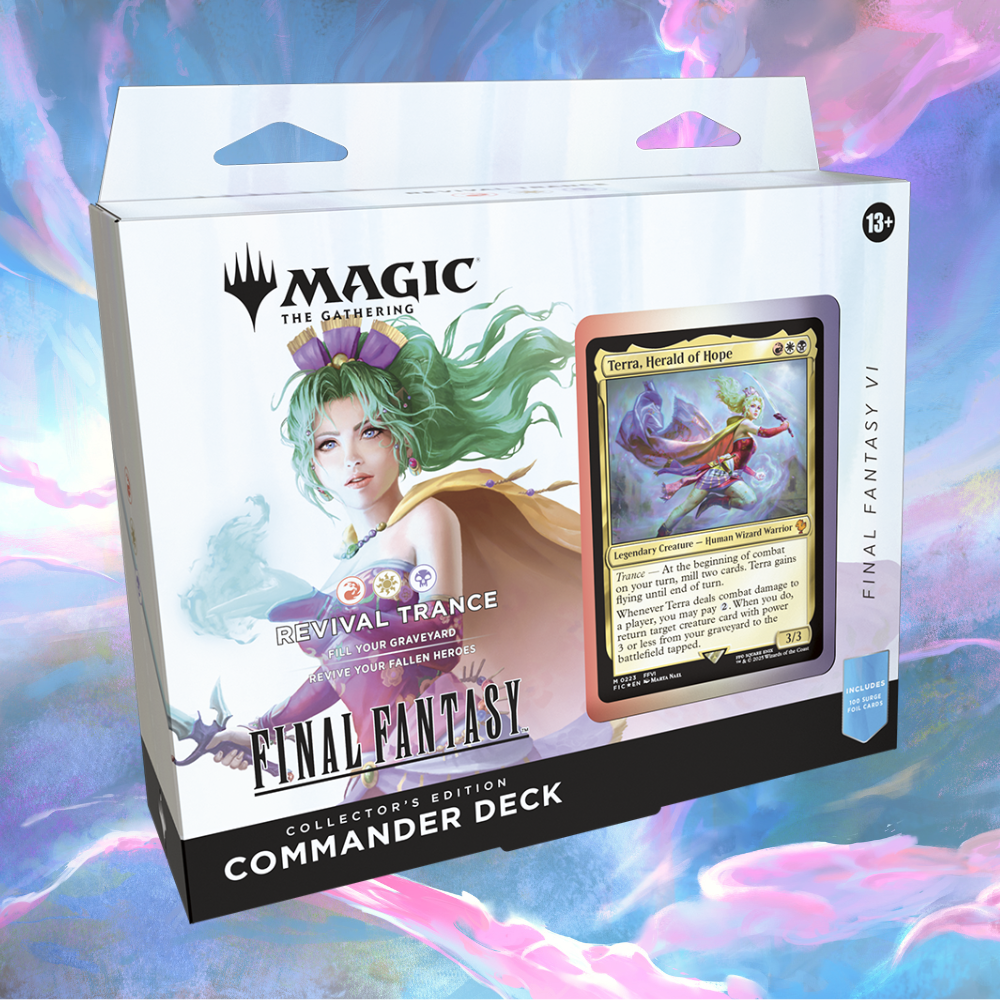
Magic: The Gathering’s Commander format is one of the most popular ways to play the game, not just because of the cards themselves, but because of the stories the decks tell. Unlike traditional formats where you simply race to reduce your opponent’s life total, Commander decks (built around a legendary creature, vehicle or Planeswalker as the “commander”) emphasise personality and long-term strategy.
At the start of the game, your commander sits just outside the battlefield, waiting to be summoned. This guarantees you always have access to your deck’s centrepiece. That’s a reassuring anchor in a 100-card singleton deck.
There are no duplicates except for basic lands in a commander deck and this naturally encourages variety and creativity. It means you can’t just load up on four copies of your best spell (like you can in Standard or Modern). Commander is also an eternal format, meaning nearly every card ever printed in Magic is legal (barring the official ban list). This allows you to experiment with older, quirky, or niche cards that might never see play in competitive formats.
Because of the multiplayer nature of Commander, the decks aren’t just about raw efficiency; they’re about identity. Each style of deck embodies a different approach to the political and often unpredictable battlefield. Commander decks push players to explore unusual strategies, use a wider card pool, and personalise their decks. As a result, no two Commander decks feel the same, even if they share colours or archetypes.
Imagine one table where a player pilots a Gruul (red/green) ramp deck, piling up lands and summoning colossal dragons until the board shakes. Across from them sits an Azorius (white/blue) control player, calmly leaving mana untapped, ready to counter those dragons and keep the board under their thumb. Next, someone shuffles up a Rakdos (black/red) sacrifice deck, turning their own creatures into fuel for devastating effects. And finally, perhaps, a Selesnya (green/white) token army, which quietly builds up a small army of soldiers and plants until the battlefield erupts in an overwhelming flood of creatures. The beauty of a Commander Deck is how these identities don’t just affect your gameplay but also shape the social dynamic. Some decks draw immediate attention while others fly under the radar until it’s too late. Some win explosively, others through patience.
Notable Things About Commander Decks
- 100-card singleton: Every card (besides basic lands) must be unique, making deckbuilding diverse.
- Commander identity: Your commander defines your deck’s colours and style.
- Multiplayer focus: Usually pods with four players, meaning politics and table dynamics matter as much as raw power and strategy.
- Commander tax and normal costs: When casting your commander from the command zone, you pay its normal costs first, plus an additional two mana for each previous time it has been cast from the command zone.
- Commander damage: A player loses the game if they are dealt 21 or more combat damage by the same commander over the course of the game, tracked even if the commander changes zones or controllers.
- Power level: Decks can range from casual to highly competitive, so understanding power level helps set expectations for gameplay.
- Varied win conditions: Life total reduction, “combo” wins, overwhelming armies, alternate win conditions (like Laboratory Maniac or Approach of the Second Sun).
Key Types of Commander Decks and Their Traits
1. Aggro / Combat-Focused Decks
- Playstyle: Win by overwhelming opponents with creatures and combat damage.
- Example Commanders: Edgar Markov (vampires), Xenagos, God of Revels (big attackers), Najeela, the Blade-Blossom (warriors).
- Traits: Fast-paced, thrives when opponents stumble, often a lightning rod for removal. These decks are especially fun to play, offering the excitement of big swings and the thrill of reaching a key point in the game where a single attack can decide the outcome. Picture a board full of creatures marching toward victory, creating memorable moments.
2. Control Decks
- Playstyle: Slow the game down, deny threats, and win with inevitability.
- Example Commanders: Azami, Lady of Scrolls (card draw, wizards), Narset, Enlightened Exile (spellslinger).
- Traits: Heavy on counters, board wipes, and card advantage. Interaction is a core element, with instant-speed spells providing flexibility and allowing you to respond to threats efficiently. Control decks are expected to dominate the long game, often frustrating opponents but rewarding patient play.
3. Combo Decks
- Playstyle: Assemble specific pieces for a game-ending loop or synergy.
- Example Commanders: Urza, Lord High Artificer (artifacts), Korvold, Fae-Cursed King (sacrifice engine), The Gitrog Monster (lands).
- Traits: Often slow or sneaky until suddenly explosive; opponents must monitor them carefully. The expected hallmark of combo decks is their ability to win out of nowhere, often at the point when the table least expects it.
4. Midrange / Value Decks
- Playstyle: Flexible, playing efficient cards that scale well over time.
- Example Commanders: Meren of Clan Nel Toth (recursion), Atraxa, Praetors’ Voice (proliferate+ value), Roon of the Hidden Realm (blink, form manipulation).
- Traits: Adaptable, good at grinding, strong resilience to removal. Some midrange decks manipulate different forms or states, such as blink or all-form effects, to maximize value and maintain board presence.
5. Tribal Decks
- Playstyle: Build around one creature type for synergy.
- Example Commanders: Sliver Overlord (slivers), Krenko, Mob Boss (goblins), Ayula, Queen Among Bears (bears).
- Traits: Cohesive identity, synergy-driven, often snowball once critical mass is reached. Wizards and zombies are especially popular tribal themes, each with unique gameplay and interaction.
6. Tokens / Go-Wide Decks
- Playstyle: Make many creatures, then pump them for massive swings.
- Example Commanders: Rhys the Redeemed (elves/tokens), Trostani, Selesnya’s Voice (lifegain + tokens).
- Traits: Explosive board states, weak to wipes, strong in attrition if supported.
7. Politics / Group Hug Decks
- Playstyle: Encourage other players, offer resources, manipulate table dynamics.
- Example Commanders: Phelddagrif (group hug), Zedruu the Greathearted (gifting).
- Traits: Don’t always aim to win directly; thrive by influencing outcomes and “kingmaking.”
8. Stax / Prison Decks
- Playstyle: Deny resources, slow down the entire table, and win by grinding others out.
- Example Commanders: Grand Arbiter Augustin IV (taxing spells), Derevi, Empyrial Tactician (resource denial).
- Traits: Oppressive but effective, demands strong piloting and politics to avoid being targeted immediately.
The Command Zone
One of the defining features of the commander format is the command zone, which is a special area that sets Commander apart from other Magic: The Gathering formats. At the beginning of every game, each player places their chosen commander face up in the command zone, making it visible and accessible to everyone at the table. This unique mechanic ensures that your deck’s legendary creature is always within reach, ready to lead your strategy whenever you need it.
Casting your commander from the command zone follows its normal mana cost, but with a twist: each time you cast it from the command zone after it’s been sent there (for example, if it was destroyed or exiled), you must pay an additional two mana for each previous time you’ve cast it this way. This “commander tax” adds a layer of strategy, as players must weigh the benefits of recasting their commander against the increasing cost. The command zone also acts as a safety net because if your commander would be put into your graveyard, library, hand or exile, you can choose to return it to the command zone instead. This keeps your commander in play as a recurring threat and a consistent source of advantage throughout the game.
Mastering the command zone is essential for building a competitive commander deck and executing effective strategies in the multiplayer format. Whether you’re planning to cast your commander multiple times or use it as a key part of your deck’s win condition, understanding how to leverage the command zone can give you a significant edge in gameplay. The command zone is where your deck’s story begins, and often where victory is dictated.
Colour Identity and Deck-Building
Color identity is at the heart of every commander deck, shaping not only which cards you can include but also the strategies and synergies you can explore. In the commander format, a card’s color identity is determined by all the mana symbols in its casting cost and rules text. This means your deck can only contain cards that match your commander’s color identity, with the exception of colorless cards, which are fair game for any deck.
This rule is more than just a deck-building restriction - it’s a creative challenge that encourages players to build around their commander’s unique abilities and strengths. When you sit down to design your commander deck, you’re not just picking powerful cards; you’re crafting a strategy that takes advantage of your commander’s color palette. This focus on color identity leads to a variety of decks and playstyles, from mono-color powerhouses to five-color alliances that can access the full spectrum of Magic’s spells.
A well-constructed deck with a clear color identity doesn’t just maximize card advantage, it also helps you develop a strong, consistent game plan that can stand up to the unpredictable nature of multiplayer games. Whether you’re playing with friends at the kitchen table or competing in your local community, understanding color identity is key to unlocking the full potential of your deck. It’s what makes each commander deck feel like a unique adventure, and what keeps the format fresh and exciting for players around the world.